

When I married someone with two kids and brought my own daughter into the mix, figuring out the best insurance basics for blended families hit me like a wall I didn’t see coming. Nobody warns you that combining lives means combining policies, beneficiaries, and a whole mess of legal fine print. Every form asked questions I didn’t have answers to. I spent months sorting through gaps that could have left my family exposed. Here’s what actually matters.
Why Blended Families Face Unique Insurance Challenges
Standard insurance advice assumes a traditional household structure. Two biological parents, their kids, one set of last names. Blended families break every one of those assumptions.
You might have stepchildren who aren’t legally yours, an ex-spouse still listed as a beneficiary on an old life insurance policy, or kids bouncing between two households with two different health plans. I found out my stepdaughter wasn’t automatically covered under my employer’s health plan because I hadn’t formally adopted her. That was a fun phone call to HR.
The reality is that coverage gaps hide in places you wouldn’t think to look. Custody agreements, divorce decrees, and state laws all influence who qualifies for what. If you assume everything transfers smoothly when you blend households, you’re setting yourself up for a painful surprise when someone actually needs to file a claim.
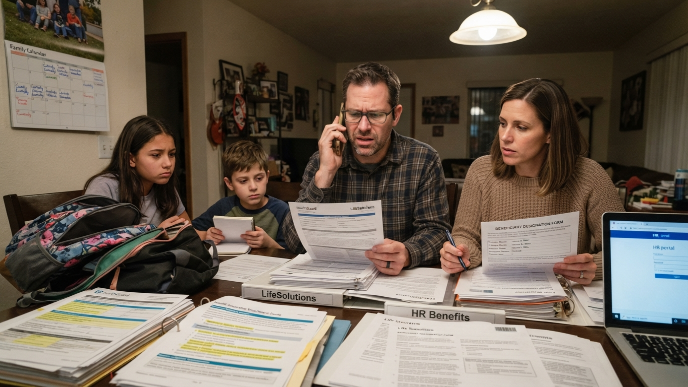
Health Insurance: Who Covers Which Kids?
This one created the most headaches in my house. When both biological parents carry health insurance through their employers, you need to figure out which plan covers the kids, and whether stepchildren qualify at all.
Most employer plans allow you to add stepchildren, but only if they live in your household or you can prove financial dependency. Some states require it, others don’t. I called my insurance company three separate times and got three different answers before a supervisor finally clarified the rules for my state.
The Birthday Rule
If both biological parents have coverage, most insurers use the “birthday rule” to determine which plan is primary for the children. The parent whose birthday falls earlier in the calendar year has the primary plan. It has nothing to do with age, just the month and day. This tripped me up because I assumed the custodial parent’s plan always came first. It doesn’t.
Check your divorce decree too. Courts sometimes specify which parent must carry health insurance for the children, and that overrides the birthday rule. If you skip this step, you could end up paying out of pocket for claims that should have been covered.
Life Insurance Needs a Serious Second Look
Here’s where blended families really need to pay attention. Life insurance isn’t just about replacing income. It’s about making sure every kid in the household is financially protected if something happens to a biological parent.
I had a $500,000 term policy from before my remarriage. My ex-wife was still the beneficiary. That meant if I died, my new spouse and stepchildren would get nothing, while my ex received everything. Not exactly what I intended for my current family’s security.
Update your beneficiaries immediately after remarriage. But here’s the catch: some divorce agreements legally require you to maintain your ex-spouse or your biological children as beneficiaries on a certain amount of coverage. You can’t just swap names without checking. I ended up buying a second term policy through Haven Life to cover my new family separately while keeping the original policy intact for my daughter’s benefit per the divorce agreement.
Term life insurance is usually the most affordable option for blended families because you can stack multiple policies for different purposes without breaking the bank.

The Best Insurance Basics for Blended Families Start With Beneficiary Audits
If you take one thing from this entire article, make it this: audit every single beneficiary designation you have. Not just life insurance. Retirement accounts, 401(k)s, IRAs, even bank accounts with payable-on-death designations.
Beneficiary designations override your will. I’ll say that again because it’s that important. If your 401(k) still lists your ex-spouse as the beneficiary, they get that money when you die, even if your will says everything goes to your current spouse. Courts have upheld this repeatedly.
I sat down one Saturday morning with a spreadsheet and listed every financial account, every policy, and every designation. It took about two hours. I found three accounts that still listed my ex. Fixing them took less than 30 minutes total. That two-hour audit might be the most valuable thing I’ve ever done for my family’s financial protection.
Go through your spouse’s accounts too. Blended family protection is a two-person job.
Homeowners and Auto Insurance: Stepchildren Count
People obsess over health and life insurance but forget that homeowners and auto insurance need updates when you blend households. Adding a new spouse to your homeowners policy is usually straightforward, but you also need to account for additional personal property, liability exposure, and any teenage stepchildren who might be driving soon.
My stepson turned 16 four months after I moved in. My auto insurer needed to know about him even before he got his license because he lived in the household and had access to vehicles. Failing to disclose household members can give your insurance company a reason to deny a claim. State Farm was pretty clear about this when I called.
Get your homeowners liability limit reviewed too. More people in the house means more potential liability. A standard $100,000 liability limit feels thin when you’ve got four kids and their friends running around the backyard. I bumped mine to $300,000 and added an umbrella policy for another $1 million. The umbrella cost me about $200 a year, which felt like a bargain for that level of peace of mind.
Disability Insurance: The Policy Nobody Thinks About
Everyone talks about life insurance for blended families. Almost nobody mentions disability insurance, and that’s a mistake. You’re far more likely to become disabled during your working years than to die. If the primary earner in a blended family can’t work for six months, the financial fallout hits harder because there are more people depending on that income.
My employer offered short-term and long-term disability coverage, but it only replaced 60% of my base salary. When I factored in child support obligations plus the household expenses for my blended family, 60% wasn’t going to cut it. I added a supplemental policy through Breeze that filled the gap.
If your blended family depends on two incomes, both earners need disability coverage. Not just one. Losing either income stream can create a cascade of problems, especially if child support or alimony payments are involved.

Estate Planning and Insurance Go Hand in Hand
Insurance without proper estate planning is like locking your front door but leaving the windows wide open. In blended families, you absolutely need a will, and in most cases, a trust.
Without a trust, your life insurance payout goes directly to your named beneficiary. If that’s your current spouse, there’s no legal guarantee they’ll use any of it to support your biological children from a previous marriage. I’m not saying your spouse wouldn’t do the right thing. I’m saying the law won’t force them to, and people’s circumstances change.
A revocable living trust lets you direct exactly how insurance proceeds get distributed. You can specify that a portion goes to your biological children’s education fund while the rest supports your surviving spouse. An estate planning attorney who works with blended families can set this up for roughly $1,500 to $3,000 depending on complexity. I used a local attorney rather than an online service because our situation had enough moving parts that I wanted someone who could ask the right follow-up questions.

Frequently Asked Questions
Do stepchildren automatically get covered on my health insurance?
Not always. Most employer-sponsored plans allow you to add stepchildren, but some require proof of legal guardianship, adoption, or that the child lives in your household full time. Check with your HR department and your specific plan documents. State laws vary, so what works in Texas might not apply in Ohio. Always confirm before assuming coverage exists.
What happens to insurance basics for blended families after a divorce decree?
Your divorce decree might require you to maintain specific insurance coverage for your biological children, like a minimum life insurance amount naming them as beneficiaries. Violating these terms can result in contempt of court. Review your decree carefully before making any policy changes, and consult a family law attorney if anything seems unclear.
Should both spouses in a blended family have life insurance?
Yes, almost without exception. Both spouses likely contribute financially, whether through income, child-rearing, or managing the household. If either person dies, the surviving spouse faces real costs. Even a stay-at-home parent should carry a policy because replacing childcare, cooking, and household management gets expensive quickly.
How often should blended families review their insurance policies?
At minimum, review everything once a year and after any major life event. A new baby, a teenager getting a driver’s license, a job change, a custody modification, any of these should trigger a full review. I set a calendar reminder every January to go through all our policies and beneficiary designations.
Can my ex-spouse and I both claim the kids on separate health insurance plans?
Yes, children can have dual coverage under both parents’ plans. The birthday rule typically determines which plan is primary and which is secondary. The secondary plan can pick up costs the primary plan doesn’t cover, like copays or coinsurance. Coordination of benefits between the two insurers handles most of this automatically once both plans are aware of each other.
Conclusion
Blending a family is beautiful and messy and complicated, and the insurance side of it mirrors all of that perfectly. Getting the basics right doesn’t require perfection, just intentional effort, a couple of Saturday mornings, and the willingness to make some phone calls. What’s the one policy you’ve been putting off reviewing?