

Understanding affordable insurance basics for first time policyholders felt impossible when I was 24, staring at a quote screen with terms I couldn’t pronounce. I remember picking the cheapest plan without reading a single detail, then getting hit with a $2,800 bill my policy barely touched. That painful lesson taught me everything I’m about to share. If you’re buying your first policy, this stuff actually matters more than the monthly price tag.
Why Most First Time Buyers Pick the Wrong Plan
The biggest mistake I made was treating insurance like a subscription I’d never use. I picked the lowest premium, ignored the deductible, and assumed everything would just be “covered.” Spoiler: it wasn’t.
Most first time buyers do the same thing. A 2024 survey from Policygenius found that nearly 40% of people under 30 chose their plan based on premium alone, without comparing what the plan actually paid for. That’s like buying the cheapest umbrella at the store without checking if it actually opens.
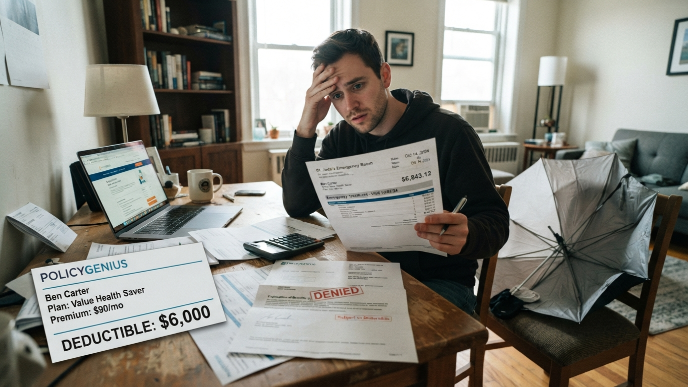
The real cost of insurance isn’t your monthly payment. It’s what you pay when something goes wrong. A $90/month plan with a $6,000 deductible can wreck your savings faster than a $150/month plan with a $1,500 deductible. You need to look at the full picture before you commit to anything.
The Core Terms You Actually Need to Know
Insurance paperwork loves to bury you in jargon. But honestly, you only need to understand about five terms to make a smart decision. Here they are, stripped of all the nonsense.
Premium is your monthly bill. That’s the easy one. Your deductible is the amount you pay out of pocket before your insurance kicks in. A copay is a fixed fee you pay for specific services, like a $30 doctor visit. Coinsurance is the percentage you split with your insurer after you meet your deductible. And your out-of-pocket maximum is the absolute most you’ll pay in a year before your insurance covers 100%.
That last one is the number most people skip over, and it’s arguably the most important one on the entire policy document. When I finally understood my out-of-pocket max, my whole approach to choosing plans changed.
Affordable Insurance Basics for First Time Policyholders: What “Affordable” Really Means
Here’s something nobody told me: affordable doesn’t mean cheap. Affordable means the plan fits your life, your health, your budget, and your risk level without leaving you exposed when you actually need help.
A truly affordable plan balances three things. First, a monthly premium you can pay without stress. Second, a deductible you could realistically cover if something happened tomorrow. Third, coverage that matches how you actually use insurance.
If you’re young, healthy, and rarely see a doctor, a high-deductible health plan (HDHP) paired with a Health Savings Account (HSA) through a provider like Fidelity or Lively can save you hundreds per year. But if you take regular medications or see specialists, a plan with higher premiums and lower copays will cost less overall. I ran the numbers both ways when I switched plans last year, and the difference was over $1,100 annually. Context matters more than the sticker price.

How to Compare Quotes Without Losing Your Mind
Comparing insurance quotes used to mean calling five different agents and sitting through sales pitches. Now you can do most of it online in about 20 minutes.
For health insurance, Healthcare.gov is your starting point if you’re in the U.S. and don’t have employer coverage. For auto insurance, I’ve had great results using tools like The Zebra and Jerry, which pull quotes from multiple carriers at once. For renters or homeowners insurance, Lemonade and Policygenius both make side-by-side comparison pretty painless.
What to Actually Compare
Don’t just look at the premium column. Pull up at least three quotes and compare them across five data points: monthly premium, annual deductible, copay structure, out-of-pocket maximum, and what’s specifically excluded. That last part is where plans hide their biggest surprises. I once had a renters policy that excluded water damage from appliance leaks. Guess what happened six months later with my dishwasher.
Write your comparison on paper or in a simple Google Sheet. Seeing the numbers side by side takes the emotion out of it and makes the right choice obvious almost every time.
Types of Insurance You Might Actually Need Right Now
Not every type of insurance is urgent when you’re just starting out. But a few are non-negotiable, and skipping them is genuinely risky.
Health insurance is number one. Even if you feel invincible, one ER visit can cost $3,000 to $10,000 without coverage. If you’re under 26, stay on a parent’s plan if possible. That’s still one of the best deals in American healthcare.
Auto insurance is legally required in almost every state if you own a car. Minimum liability coverage keeps you legal, but it won’t fix your own car after an accident. Consider adding collision and comprehensive if your car is worth more than $10,000.
Renters insurance is the one most people skip, and it costs about $15 to $20 per month through companies like Lemonade or State Farm. It covers your stuff if it’s stolen, damaged by fire, or destroyed in a covered event. I didn’t have it when my apartment flooded, and replacing my laptop, furniture, and clothes cost me over $4,000 out of pocket. Never again.
Life insurance and disability insurance can wait if you’re single with no dependents, but the moment someone relies on your income, put them on your list.
Mistakes I Made So You Don’t Have To
My first auto insurance policy had state minimum coverage because I wanted the lowest possible bill. I was paying $87 a month and felt smart about it. Then I rear-ended someone at a stoplight, and my liability cap barely covered their bumper repair. I owed the rest out of pocket.
My second mistake was ignoring the network on my health insurance plan. I picked an HMO because it was $40 cheaper per month than the PPO. Then I found out my doctor wasn’t in-network, and a routine visit that should have cost me $30 ended up costing $280.
The third mistake was never reading my policy documents. I know, nobody wants to read 30 pages of fine print. But you don’t have to read all of it. Just search for the words “exclusion,” “limitation,” and “waiting period.” Those three sections tell you exactly where your coverage has gaps. Fifteen minutes of reading can save you thousands.

Smart Ways to Lower Your Premiums Without Cutting Coverage
You don’t have to sacrifice protection to save money. A few simple moves can drop your rates noticeably.
Bundling is the easiest win. If you get auto and renters insurance from the same company, most insurers knock 5% to 15% off both policies. I bundle mine through Progressive and save about $22 a month.
Raising your deductible from $500 to $1,000 on auto insurance can lower your premium by 15% to 30%, depending on your carrier. Just make sure you have that $1,000 accessible in savings. Setting up autopay often gives you another small discount, usually around 3% to 5%.
For health insurance, contributing to an HSA if you’re on a qualifying high-deductible plan gives you a tax break and builds a medical emergency fund at the same time. The 2024 individual contribution limit is $4,150, and every dollar goes in pre-tax. That’s free money you’re leaving on the table if you skip it.
Ask about every discount. Student discounts, safe driver discounts, non-smoker discounts, loyalty discounts. Insurers rarely volunteer these. You have to ask directly.
When to Reassess Your Coverage
Your insurance needs shift as your life changes, and most people forget to update their policies. I kept the same bare-bones renters policy for three years, even after I’d bought new furniture, a better laptop, and camera equipment worth about $2,500. If something had happened, my coverage limit wouldn’t have come close.
Review your policies once a year, ideally a month before renewal. Check if your coverage limits still match what you own and what you earn. Compare fresh quotes from competitors because loyalty doesn’t always pay in insurance. I switched auto insurers last year and saved $340 annually for the exact same coverage.
Big life events should trigger an immediate review too. Moving, getting married, having a kid, buying a car, starting a business. Each one changes your risk profile, and your coverage should reflect that.

FAQs
What’s the most affordable type of insurance for someone just starting out?
Renters insurance is usually the cheapest and most underrated. Plans from Lemonade or State Farm start around $10 to $20 per month and cover theft, fire damage, and personal liability. For the cost of a couple of coffees, you’re protecting thousands of dollars worth of belongings. It’s the easiest first policy to get right.
How much should a first time policyholder budget for insurance each month?
It depends on what you need, but a rough starting point for a young adult is $200 to $400 per month total across health, auto, and renters insurance. Health insurance is typically the biggest chunk. Shopping around and bundling policies can bring that number down significantly without reducing your actual protection.
Can I get affordable insurance basics for first time policyholders without an agent?
Absolutely. Online platforms like Healthcare.gov, The Zebra, Policygenius, and Lemonade let you compare and buy policies without ever talking to an agent. That said, if your situation is complex, like you’re self-employed or have specific health needs, a one-time consultation with an independent broker can be worth the time.
Is the cheapest plan always the worst option?
Not always, but usually the cheapest plan has the highest deductible and the most exclusions. The key is reading what’s actually covered before you buy. Sometimes a cheap plan fits your situation perfectly. Other times, spending an extra $30 to $50 a month gives you dramatically better coverage when you need it most.
How do I know if I have enough coverage?
Add up the value of what you’re protecting, your belongings, your car, your health costs, and your income if someone depends on it. Then compare that total to your policy limits. If there’s a big gap, you’re underinsured. Doing this exercise once a year takes about 20 minutes and can save you from a brutal surprise.
Conclusion
Getting your first insurance policy doesn’t have to feel like gambling with fine print. Once you understand a handful of terms and know what questions to ask, the whole process gets a lot less intimidating. So what’s the one thing about insurance that’s been confusing you the most?